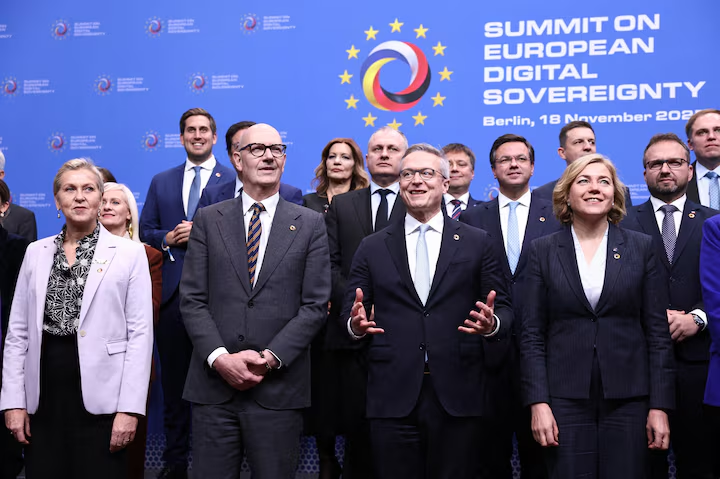
BRUSSELS, June 3 (Reuters) – The European Commission proposed new laws on Wednesday to boost domestic cloud, AI and semiconductor industries, aiming to cut reliance on U.S. Big Tech in a move that could ratchet up transatlantic tensions.
The Cloud and AI Development Act and Chips Act 2.0 form part of Europe’s push for technological sovereignty and its efforts to close the gap with U.S. and Chinese rivals. The Commission wants to double the EU’s global market share of semiconductors to 20% by 2030.
“We cannot afford to depend on others for the technologies that keep our hospitals running, our energy grids stable and our services secure,” Commission President Ursula von der Leyen said in a statement.
EU tech chief Henna Virkkunen warned of the risk of potential ‘kill switches’ that could disable or disrupt services.
“We want to be sure that in the critical fields we are always able to control the services and control the data in Europe,” she told reporters.
The proposal sets out sovereignty requirements for cloud providers in sensitive sectors such as banking, energy and healthcare, driven in part by concerns over U.S. laws such as the Cloud Act which requires U.S.-based providers to grant authorities access to data even if it is stored abroad.
For critical public contracts, vendors will be required to ensure that software and hardware are made in the EU, excluding non-European companies from controlling data and services, EU tech chief Henna Virkkunen told reporters, confirming a Reuters story.
“Of course this is not a very big part of our services but in very critical fields like defence for example, it is very important that the technology is controlled by Europeans from Europe and also data is staying here,” she said.
Amazon (AMZN.O), opens new tab, Microsoft (MSFT.O), opens new tab and Google (GOOGL.O), opens new tab, the world’s three biggest cloud providers with a market share of over 60%, have come up with various ways to address EU concerns.
“Microsoft offers secure and sovereign cloud solutions that put customers in control, and we stand ready to help build a strong, resilient and globally connected AI ecosystem in Europe,” a Microsoft spokesperson.
Microsoft has launched locally-controlled cloud ventures such as Bleu, owned by France’s Capgemini and Orange, and Delos Cloud, an SAP subsidiary using Microsoft Azure infrastructure in an effort to address Europe’s sovereignty concerns.
The EU proposal also includes a fast-track approval process for data centres which will get preferential grid access and reduced network charges for using European-made chips and improving energy efficiency.
The updated Chips Act aims to boost European-made chips by encouraging agreements between manufacturers and buyers to guarantee future purchases of a product.
Both proposals will be negotiated with EU member states and the European Parliament in the coming months before they can become law.
Reporting by Foo Yun Chee, additional reporting by Bart Meijers; Editing by Elaine Hardcastle

Stay ahead with ITBusinessNews – Your trusted source for Technology and Business news. Fast & Precise
- ITBN EDITORIAL TEAM
- ITBN EDITORIAL TEAM
- ITBN EDITORIAL TEAM
- ITBN EDITORIAL TEAM
- ITBN EDITORIAL TEAM
- ITBN EDITORIAL TEAM
- ITBN EDITORIAL TEAM
- ITBN EDITORIAL TEAM
- ITBN EDITORIAL TEAM
- ITBN EDITORIAL TEAM
- ITBN EDITORIAL TEAM
- ITBN EDITORIAL TEAM
- ITBN EDITORIAL TEAM
- ITBN EDITORIAL TEAM
- ITBN EDITORIAL TEAM
- ITBN EDITORIAL TEAM
- ITBN EDITORIAL TEAM
- ITBN EDITORIAL TEAM
- ITBN EDITORIAL TEAM
- ITBN EDITORIAL TEAM
- ITBN EDITORIAL TEAM
- ITBN EDITORIAL TEAM
- ITBN EDITORIAL TEAM
- ITBN EDITORIAL TEAM
- ITBN EDITORIAL TEAM
- ITBN EDITORIAL TEAM
- ITBN EDITORIAL TEAM
- ITBN EDITORIAL TEAM
- ITBN EDITORIAL TEAM
- ITBN EDITORIAL TEAM
- ITBN EDITORIAL TEAM
- ITBN EDITORIAL TEAM
- ITBN EDITORIAL TEAM
- ITBN EDITORIAL TEAM
- ITBN EDITORIAL TEAM
- ITBN EDITORIAL TEAM
- ITBN EDITORIAL TEAM
- ITBN EDITORIAL TEAM
- ITBN EDITORIAL TEAM
- ITBN EDITORIAL TEAM
- ITBN EDITORIAL TEAM
- ITBN EDITORIAL TEAM
- ITBN EDITORIAL TEAM
- ITBN EDITORIAL TEAM
- ITBN EDITORIAL TEAM
- ITBN EDITORIAL TEAM
- ITBN EDITORIAL TEAM
- ITBN EDITORIAL TEAM
- ITBN EDITORIAL TEAM
- ITBN EDITORIAL TEAM
- ITBN EDITORIAL TEAM
- ITBN EDITORIAL TEAM
- ITBN EDITORIAL TEAM
- ITBN EDITORIAL TEAM
- ITBN EDITORIAL TEAM
- ITBN EDITORIAL TEAM
- ITBN EDITORIAL TEAM
- ITBN EDITORIAL TEAM
- ITBN EDITORIAL TEAM
- ITBN EDITORIAL TEAM
- ITBN EDITORIAL TEAM
- ITBN EDITORIAL TEAM
- ITBN EDITORIAL TEAM
- ITBN EDITORIAL TEAM
- ITBN EDITORIAL TEAM
- ITBN EDITORIAL TEAM
- ITBN EDITORIAL TEAM
- ITBN EDITORIAL TEAM
- ITBN EDITORIAL TEAM
- ITBN EDITORIAL TEAM
- ITBN EDITORIAL TEAM
- ITBN EDITORIAL TEAM
- ITBN EDITORIAL TEAM
- ITBN EDITORIAL TEAM
- ITBN EDITORIAL TEAM
- ITBN EDITORIAL TEAM
- ITBN EDITORIAL TEAM
- ITBN EDITORIAL TEAM
- ITBN EDITORIAL TEAM
- ITBN EDITORIAL TEAM
- ITBN EDITORIAL TEAM
- ITBN EDITORIAL TEAM
- ITBN EDITORIAL TEAM
- ITBN EDITORIAL TEAM
- ITBN EDITORIAL TEAM
- ITBN EDITORIAL TEAM
- ITBN EDITORIAL TEAM
- ITBN EDITORIAL TEAM
- ITBN EDITORIAL TEAM
- ITBN EDITORIAL TEAM
- ITBN EDITORIAL TEAM
- ITBN EDITORIAL TEAM
- ITBN EDITORIAL TEAM
- ITBN EDITORIAL TEAM
- ITBN EDITORIAL TEAM
- ITBN EDITORIAL TEAM
- ITBN EDITORIAL TEAM
- ITBN EDITORIAL TEAM
- ITBN EDITORIAL TEAM
- ITBN EDITORIAL TEAM
- ITBN EDITORIAL TEAM
- ITBN EDITORIAL TEAM
- ITBN EDITORIAL TEAM
- ITBN EDITORIAL TEAM
- ITBN EDITORIAL TEAM
- ITBN EDITORIAL TEAM
- ITBN EDITORIAL TEAM
- ITBN EDITORIAL TEAM
- ITBN EDITORIAL TEAM
- ITBN EDITORIAL TEAM
- ITBN EDITORIAL TEAM
- ITBN EDITORIAL TEAM
- ITBN EDITORIAL TEAM
- ITBN EDITORIAL TEAM
- ITBN EDITORIAL TEAM
- ITBN EDITORIAL TEAM
- ITBN EDITORIAL TEAM
- ITBN EDITORIAL TEAM
- ITBN EDITORIAL TEAM
- ITBN EDITORIAL TEAM
- ITBN EDITORIAL TEAM
- ITBN EDITORIAL TEAM
- ITBN EDITORIAL TEAM
- ITBN EDITORIAL TEAM
- ITBN EDITORIAL TEAM
- ITBN EDITORIAL TEAM
- ITBN EDITORIAL TEAM
- ITBN EDITORIAL TEAM
- ITBN EDITORIAL TEAM
- ITBN EDITORIAL TEAM
- ITBN EDITORIAL TEAM
- ITBN EDITORIAL TEAM
- ITBN EDITORIAL TEAM
- ITBN EDITORIAL TEAM
- ITBN EDITORIAL TEAM
- ITBN EDITORIAL TEAM
- ITBN EDITORIAL TEAM
- ITBN EDITORIAL TEAM
- ITBN EDITORIAL TEAM
- ITBN EDITORIAL TEAM
- ITBN EDITORIAL TEAM
- ITBN EDITORIAL TEAM
- ITBN EDITORIAL TEAM
- ITBN EDITORIAL TEAM
- ITBN EDITORIAL TEAM
- ITBN EDITORIAL TEAM
- ITBN EDITORIAL TEAM
- ITBN EDITORIAL TEAM
- ITBN EDITORIAL TEAM
- ITBN EDITORIAL TEAM
- ITBN EDITORIAL TEAM
- ITBN EDITORIAL TEAM
- ITBN EDITORIAL TEAM
- ITBN EDITORIAL TEAM
- ITBN EDITORIAL TEAM
- ITBN EDITORIAL TEAM
- ITBN EDITORIAL TEAM
- ITBN EDITORIAL TEAM
- ITBN EDITORIAL TEAM
- ITBN EDITORIAL TEAM
- ITBN EDITORIAL TEAM
- ITBN EDITORIAL TEAM
- ITBN EDITORIAL TEAM
- ITBN EDITORIAL TEAM
- ITBN EDITORIAL TEAM
- ITBN EDITORIAL TEAM
- ITBN EDITORIAL TEAM
- ITBN EDITORIAL TEAM
- ITBN EDITORIAL TEAM
- ITBN EDITORIAL TEAM
- ITBN EDITORIAL TEAM
- ITBN EDITORIAL TEAM
- ITBN EDITORIAL TEAM
- ITBN EDITORIAL TEAM
- ITBN EDITORIAL TEAM
- ITBN EDITORIAL TEAM
- ITBN EDITORIAL TEAM
- ITBN EDITORIAL TEAM
- ITBN EDITORIAL TEAM
- ITBN EDITORIAL TEAM
- ITBN EDITORIAL TEAM
- ITBN EDITORIAL TEAM
- ITBN EDITORIAL TEAM
- ITBN EDITORIAL TEAM
- ITBN EDITORIAL TEAM
- ITBN EDITORIAL TEAM
- ITBN EDITORIAL TEAM
- ITBN EDITORIAL TEAM
- ITBN EDITORIAL TEAM
- ITBN EDITORIAL TEAM
- ITBN EDITORIAL TEAM
- ITBN EDITORIAL TEAM
- ITBN EDITORIAL TEAM
- ITBN EDITORIAL TEAM
- ITBN EDITORIAL TEAM
- ITBN EDITORIAL TEAM
- ITBN EDITORIAL TEAM
- ITBN EDITORIAL TEAM
- ITBN EDITORIAL TEAM
- ITBN EDITORIAL TEAM
- ITBN EDITORIAL TEAM
- ITBN EDITORIAL TEAM
- ITBN EDITORIAL TEAM
- ITBN EDITORIAL TEAM
- ITBN EDITORIAL TEAM
- ITBN EDITORIAL TEAM
- ITBN EDITORIAL TEAM
- ITBN EDITORIAL TEAM
- ITBN EDITORIAL TEAM
- ITBN EDITORIAL TEAM
- ITBN EDITORIAL TEAM
- ITBN EDITORIAL TEAM
- ITBN EDITORIAL TEAM
- ITBN EDITORIAL TEAM
- ITBN EDITORIAL TEAM
- ITBN EDITORIAL TEAM
- ITBN EDITORIAL TEAM
- ITBN EDITORIAL TEAM
- ITBN EDITORIAL TEAM
- ITBN EDITORIAL TEAM
- ITBN EDITORIAL TEAM
- ITBN EDITORIAL TEAM
- ITBN EDITORIAL TEAM
- ITBN EDITORIAL TEAM
- ITBN EDITORIAL TEAM
- ITBN EDITORIAL TEAM
- ITBN EDITORIAL TEAM
- ITBN EDITORIAL TEAM
- ITBN EDITORIAL TEAM
- ITBN EDITORIAL TEAM
- ITBN EDITORIAL TEAM
- ITBN EDITORIAL TEAM
- ITBN EDITORIAL TEAM
- ITBN EDITORIAL TEAM
- ITBN EDITORIAL TEAM
- ITBN EDITORIAL TEAM
- ITBN EDITORIAL TEAM
- ITBN EDITORIAL TEAM
- ITBN EDITORIAL TEAM
- ITBN EDITORIAL TEAM
- ITBN EDITORIAL TEAM
- ITBN EDITORIAL TEAM
- ITBN EDITORIAL TEAM
- ITBN EDITORIAL TEAM
- ITBN EDITORIAL TEAM
- ITBN EDITORIAL TEAM
- ITBN EDITORIAL TEAM
- ITBN EDITORIAL TEAM
- ITBN EDITORIAL TEAM
- ITBN EDITORIAL TEAM
- ITBN EDITORIAL TEAM
- ITBN EDITORIAL TEAM
- ITBN EDITORIAL TEAM
- ITBN EDITORIAL TEAM
- ITBN EDITORIAL TEAM
- ITBN EDITORIAL TEAM
- ITBN EDITORIAL TEAM
- ITBN EDITORIAL TEAM
- ITBN EDITORIAL TEAM
- ITBN EDITORIAL TEAM
- ITBN EDITORIAL TEAM
- ITBN EDITORIAL TEAM
- ITBN EDITORIAL TEAM
- ITBN EDITORIAL TEAM
- ITBN EDITORIAL TEAM
- ITBN EDITORIAL TEAM
- ITBN EDITORIAL TEAM
- ITBN EDITORIAL TEAM
- ITBN EDITORIAL TEAM
- ITBN EDITORIAL TEAM
- ITBN EDITORIAL TEAM
- ITBN EDITORIAL TEAM
- ITBN EDITORIAL TEAM
- ITBN EDITORIAL TEAM
- ITBN EDITORIAL TEAM
- ITBN EDITORIAL TEAM
- ITBN EDITORIAL TEAM
- ITBN EDITORIAL TEAM
- ITBN EDITORIAL TEAM
- ITBN EDITORIAL TEAM
- ITBN EDITORIAL TEAM
- ITBN EDITORIAL TEAM
- ITBN EDITORIAL TEAM
- ITBN EDITORIAL TEAM
- ITBN EDITORIAL TEAM
- ITBN EDITORIAL TEAM
- ITBN EDITORIAL TEAM
- ITBN EDITORIAL TEAM
- ITBN EDITORIAL TEAM
- ITBN EDITORIAL TEAM
- ITBN EDITORIAL TEAM
- ITBN EDITORIAL TEAM
- ITBN EDITORIAL TEAM
- ITBN EDITORIAL TEAM
- ITBN EDITORIAL TEAM
- ITBN EDITORIAL TEAM
- ITBN EDITORIAL TEAM
- ITBN EDITORIAL TEAM
- ITBN EDITORIAL TEAM
- ITBN EDITORIAL TEAM
- ITBN EDITORIAL TEAM
- ITBN EDITORIAL TEAM
- ITBN EDITORIAL TEAM
- ITBN EDITORIAL TEAM
- ITBN EDITORIAL TEAM
- ITBN EDITORIAL TEAM
- ITBN EDITORIAL TEAM
- ITBN EDITORIAL TEAM
- ITBN EDITORIAL TEAM
- ITBN EDITORIAL TEAM
- ITBN EDITORIAL TEAM
- ITBN EDITORIAL TEAM
- ITBN EDITORIAL TEAM
- ITBN EDITORIAL TEAM
- ITBN EDITORIAL TEAM
- ITBN EDITORIAL TEAM
- ITBN EDITORIAL TEAM
- ITBN EDITORIAL TEAM
- ITBN EDITORIAL TEAM
- ITBN EDITORIAL TEAM
- ITBN EDITORIAL TEAM
- ITBN EDITORIAL TEAM
- ITBN EDITORIAL TEAM